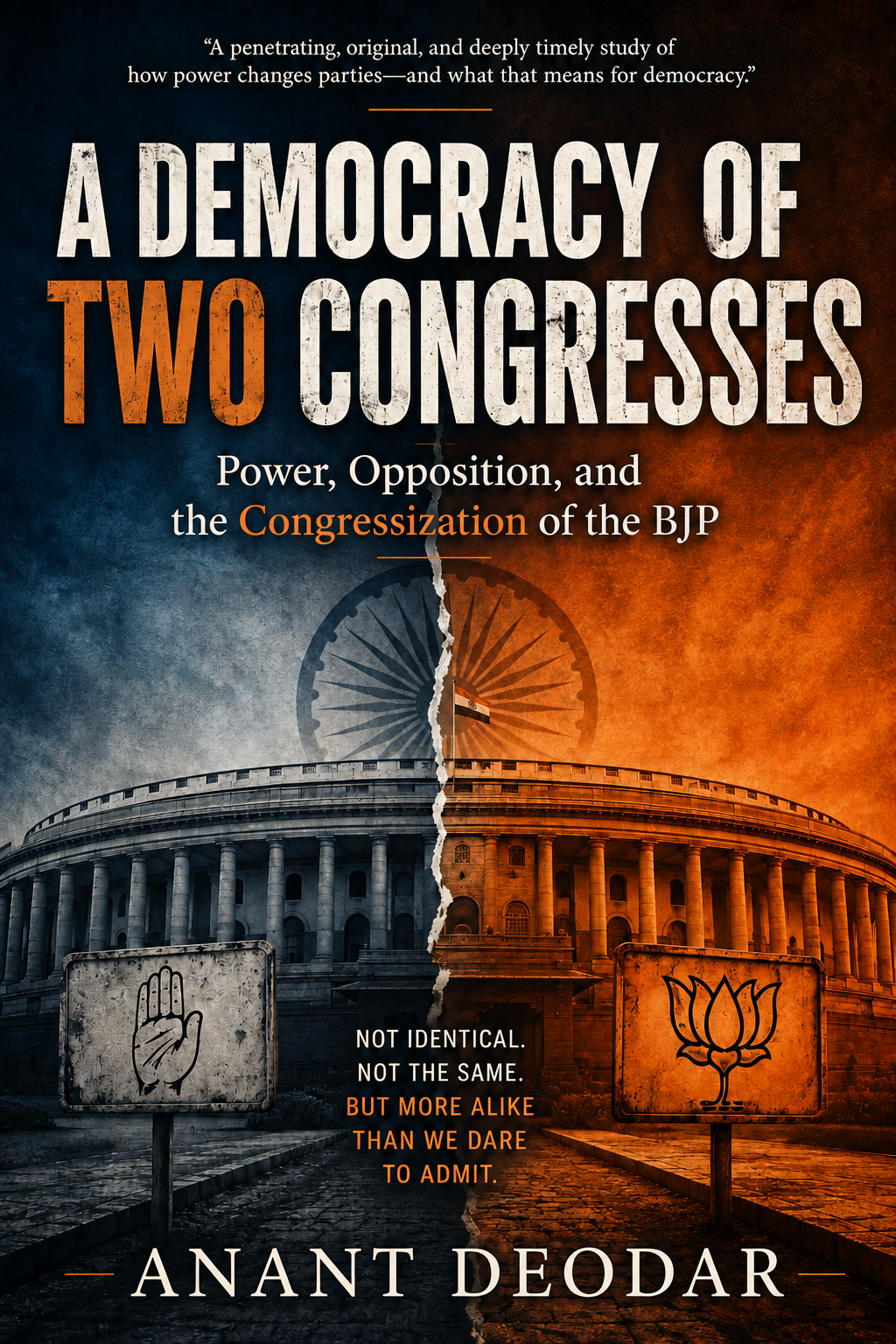
Book cover — A Democracy of Two Congresses: Parliament building split by a jagged crack, blue-grey left and amber right, Ashoka Chakra straddling the dome

State of Indian Democracy

“A vote given to one.
A responsibility
owed to none.”

A Democracy of Two Congresses

Power, Opposition, and the Congressization of the BJP · Anant Deodar

This book is not about whether the BJP is better or worse than the Congress. It is about what prolonged power does to every successful political party — and why democracies must demand accountability between elections, not just at them.

Read the Prologue

The Central Question

“Why do dominant political parties begin to resemble one another?”

Not a book about the BJP. A book about what prolonged power does to every political party.

Definition

Congressization

(n.)

— the transformation by which a once-competitive organisation, after prolonged dominance, comes to prioritise the preservation of power over the very qualities that won it power in the first place. It does not mean becoming ideologically like the Congress. It means something narrower and more structural: what Congressizes is behaviour, not belief.

“We no longer have one Congress and one BJP. We have, in every respect that matters to how power actually behaves, two Congress.”

The Book

Five Parts. One Question.

Part One The Inheritance of Power

“Is today's dominance a rupture, or an inheritance?”

Liberation Dividend Hindu Model Madam to Modi

“Call this the Liberation Dividend: political credit earned once, by defeating an order the public has come to see as exhausted, and then spent repeatedly for as long as the defeated order can be kept symbolically alive.”

1952 → 2014  Congress: 364 seats, 45% vote share → 44 seats, its worst-ever tally

1984 → 2014  BJP: 2 seats at its founding debut → 282 seats, first solo majority since 1984

Part Two The Manufacture of Consent

“Is Indian democracy run on delivery, or on narrative?”

The Bottomless Vessel Villain Inflation Who Disciplines the Press

“A voter's aspirations are a bottomless vessel, which can never be filled... Narrative does what performance structurally cannot. It declares the account settled.”

100+  deaths reported in demonetisation queues, never formally acknowledged

44% vs 27%  digital's share of India's ad market in 2025, against TV's declining share

Part Three The Opposition Problem

“Does India have a ruling-party problem, or an opposition problem?”

Congressization Friction Paradox Opposition Advantage

“India does not have a ruling-party problem. It has an opposition problem — and until that is understood, every remedy aimed at the ruling party will miss.”

~18 years  BJP's cumulative tenure at the centre — close to a fifth of the republic's life

240 seats  BJP's 2024 result, down from 303, its first coalition government since 2014

Part Four The Citizen Diminished

“What does prolonged dominance do to the person, not just the party?”

Voters vs. Citizens Beneficiaries Weak Institutions

“The more successfully an entitlement is personalised into a gift, the harder it becomes for the beneficiary who received it to audit the giver as an equal citizen would.”

6,900+  UAPA cases lodged nationwide, 2014–2020

~85%  of those cases still pending investigation at year's end

Part Five Reconciliations Conclusion

“Can a fair reckoning hold credit and criticism in the same account?”

Reluctant Incumbent Voter The Corrector's Paradox Corruption as Leveller

“RSS-shaped governance is not necessarily better governance. It is, crucially, different governance — and different is the one thing a Congressized BJP can no longer supply on its own.”

57% vs 10%  BJP's vs. Congress's share of electoral bonds funding, per disclosed 2024 data

100 years  the RSS, founded 1925 — a base no single election cycle created, and none can dissolve

By the Numbers

Numbers that don't add up.

~18

Years

BJP's cumulative tenure at the centre — close to a fifth of the republic's post-independence life

93–96%

Marked “Complete”

Smart Cities Mission projects — yet only 18 of 100 cities finished every project of their own

0.4

Jobs per 1% GDP Growth

India's rate, versus 0.7 in East Asia's fast-growth economies at comparable stages

6,900+

UAPA Cases

Lodged nationwide since 2014 — roughly 85% still pending investigation

57%

vs 10%

Electoral bonds funding split between the BJP and the Congress, per disclosed 2024 data

208

Seats — West Bengal 2026

BJP's West Bengal tally, ending Mamata Banerjee's 15 consecutive years in office

~4 cr

Ration Cards

Cancelled nationwide for non-Aadhaar-linkage

~27M

Followers in Ten Weeks

Gained by a satirical “Cockroach Janta Party” page — more than double the BJP's own Instagram following

About the Author

Anant Deodar

Anant Deodar has spent years observing Indian democracy through its elections, institutions, political movements and changing relationship with power. He writes about what happens beyond the ballot — how governments govern, how institutions hold or fail to hold power accountable, and how political alternatives change once they acquire power. A Democracy of Two Congresses is his first book.

Media & Press

Coverage

Podcast conversations, opinion pieces, and interviews will be listed here as they go live. For review copies or interview requests, reach out below.

Press Inquiries →

Read the Prologue

How It Begins

The book opens on the paradox it spends eighteen chapters answering. Here is how it begins.

An extraordinary share of India's electoral politics — from state assembly to Parliament — has become a referendum on one person: Mr. Narendra Modi. He is also not shying away from the challenge of repeatedly proving himself across the country. His promise is a currency that sways people from 'Panchayat level to Parliament'. However, when it comes to delivering on those promises, voters often find that Modi's local branch is either not working or has become too comfortable in the knowledge that Modi will win them elections. Despite the most powerful prime minister promising change, citizens either encounter incremental change or optics in the name of change at the ground level.

There is a temptation to read this as a story about one party, or one personality, and to reach reflexively for the language of authoritarian drift. That reading is available, and the danger it points to is not imaginary. But it misses the more durable problem, which is structural rather than personal. When a single figure becomes the standing referendum of election after election — when the panchayat candidate and the parliamentary candidate both run, in effect, on the same name — something happens to accountability that no mere change of leader would by itself repair. The line of responsibility that is supposed to run from the voter to the representative and back is quietly rerouted. It now runs from the voter to one man, and from that one man to no one in particular.

[...]

We still vote. We vote more fervently than ever. We have simply arranged matters so that the vote, given to one, asks nothing of anyone.

Press Kit

For journalists and podcasters

↓ Cover Art

High-resolution book cover — download for use in reviews and features

One-Sentence Summary

“This book is not about whether the BJP is better or worse than the Congress. It is about what prolonged power does to every successful political party — and why democracies must demand accountability between elections, not just at them.”

Author Bio

Anant Deodar has spent years observing Indian democracy through its elections, institutions, and political movements. He writes about what happens beyond the ballot — how governments govern, how institutions hold or fail to hold power accountable, and how political alternatives change once they acquire power. A Democracy of Two Congresses is his first book.

Campaign Line

“Not identical. Not the same. But more alike than we dare to admit.”

Stay Informed

Get Notified at Launch

No purchase link exists yet. Leave your email and we'll reach you when the book is available — and when new writing on these ideas goes live.

You're on the list.

We'll be in touch when the book is ready.

No spam. No third-party sharing. Unsubscribe any time.

Press inquiries: press@congressization.com

“2029 will not tell us whether India remains a democracy by telling us who wins. It will tell us whether the country still has the capacity to make power answerable after the winner is declared.”